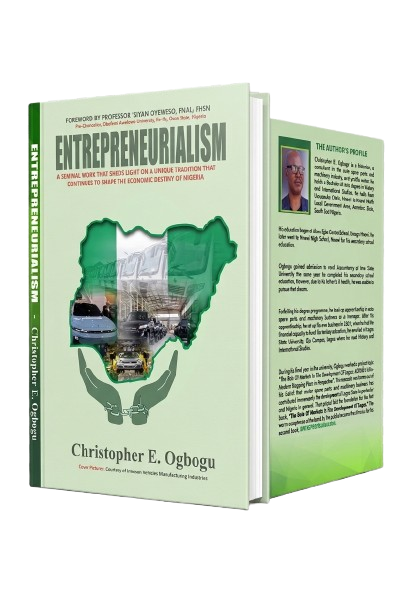
ENTREPRENEURIALISM
The Igbo Apprenticeship System and the Economic Development of Nigeria
In contemporary discourse, the Igbo tribe stands out as one of the most celebrated, envied, misunderstood, and, unfortunately, most maligned ethnic groups in Nigeria. This sentiment has persisted across generations, reflecting a complex socio-cultural and economic dynamic that warrants deeper understanding.
It is against this backdrop that I am pleased to present my work, ENTREPRENEURIALISM — a comprehensive study that chronicles the ingenuity, resilience, and business acumen of the Igbo people. The book explores the remarkable rise of the Igbo nation and its significant role in shaping the economic development of Nigeria.
ENTREPRENEURIALISM comprises 490 pages, systematically structured into three parts and twenty-four chapters, each supported by authentic references that make it a credible academic and research resource. Among its key highlights is Chapter Eight: The Igbo and Challenges of Economic Development in Nigeria, which offers an incisive analysis of the structural and policy barriers confronting Igbo entrepreneurship.
This book is dedicated to all Igbo entrepreneurs who, despite numerous constraints posed by adverse economic and fiscal policies, continue to demonstrate resilience, creativity, and an unwavering commitment to success.
ENTREPRENEURIALISM is an essential read for scholars, policymakers, and anyone seeking to understand the forces behind Igbo entrepreneurial dominance and their indispensable contribution to the Nigerian economy.
Thank you.
About The Book
There are many speculations on the economic survival and growth of the Igbo after the ugly Nigerian-Biafran civil war (1967-1970) during which almost all the wealth the people had toiled for prior to the war was wiped out. Many have discussed how the Igbo nation was able to survive economically with the egregious £20 policy of the then Federal Military Government to Igbo entrepreneurs to live on no matter the amount of money they had in their respective bank accounts before the war. Consequently, many authors have suggested how wealth became evenly distributed among the Igbo more than any other ethnic nationality globally.
This is the essence of Entrepreneurialism and the Igbo apprenticeship system. There is no doubt that the Igbo are the engine of Nigeria’s economy. Remove them from Nigeria, and the nation’s economy will crumble.
Entrepreneurialism is a book that explores the origin, growth and importance of the Igbo apprenticeship system in relation to the economic development of Lagos State and Nigeria generally. The use of ASPMDA Ultra-Modern Shopping Plaza, Lagos Int’l Trade Fair Complex, an informal sector of the economy as a model will help in understanding how the system has played a vital role in making the Igbo the most dominant group in commerce in Nigeria since the civil war. ASPMDA Plaza has become a perfect platform where Entrepreneurialism and the Igbo apprenticeship system meet. This is because almost every entrepreneur in the Plaza is a product of the Igbo apprenticeship system. Their contribution to the economic growth and development of Lagos State and Nigeria have become part of the pedestals on which the nation’s economy is defined.